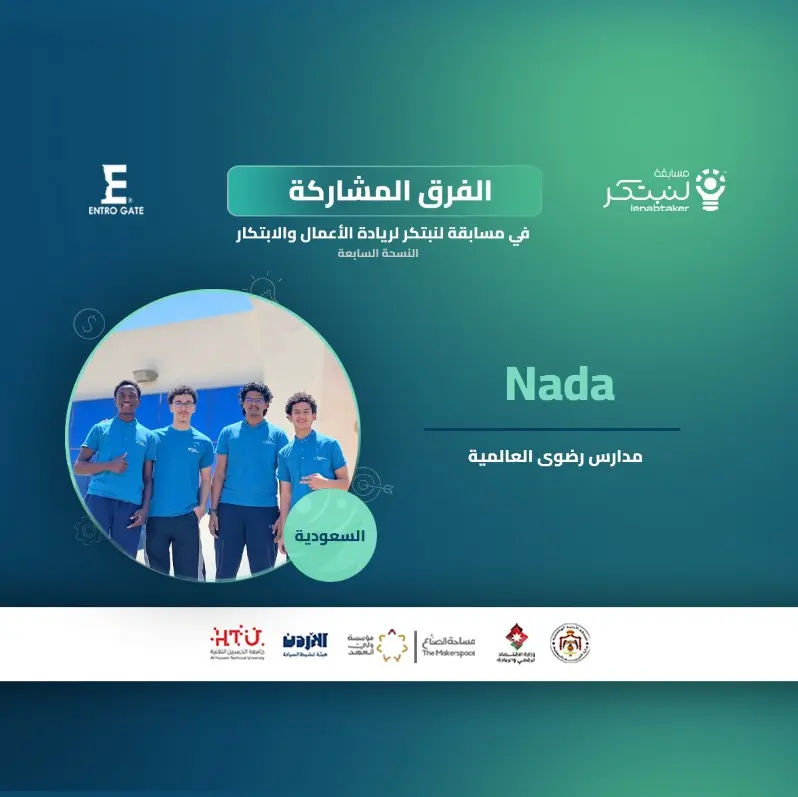


مشروع: Nada
The Middle East faces a major environmental challenge due to its ambitious reforestation goals. Despite plans to plant millions of trees in desert regions, the biggest setback remains to be the lack of fresh water for irrigation. The region has extremely limited natural water sources, and the cost of transporting water over long distances is prohibitive. Traditional irrigation methods also lead to high water loss due to evaporation in hot environments. Because of these factors, maintaining plant growth in such harsh conditions becomes very difficult. Large-scale reforestation efforts may not reach fruition without a sustainable water solution. Named “Nada” after the Arabic word translating to ""dew,"" our project stems from the technology that causes the desert to serve life where none seems to manifest. This material is created through utilizing biomimicry, an emerging field in the MENA region, most notably seen in the Albahar Towers (UAE) and the Greening Desert Project (Jordan). Unlike these large-scale projects, our idea operates as a portable material solution. By mimicking the arid Namib Desert beetle, we will engineer a surface that naturally gathers moisture from the air through hydrophilic peaks acting as magnets. This will result in these droplets naturally condensing and slipping off the peak into the container due to the hydrophobic nature of the surrounding valleys. Due to its passive simplicity and material scalability, our project is a highly feasible, high-margin solution for the region’s most finite and subsidized commodity that propels the goals of environmental sustainability: water. The unique idea of the “Nada” project is its zero-energy approach to desert reforestation. While traditional irrigation depends on costly desalination and groundwater, Nada utilizes biomimicry to harvest water directly from the atmosphere. Inspired by the Stenocara beetle, we created a physical leaf with a microscopic texture of water-attracting and water-repelling surfaces. This design allows Nada to catch dew droplets at night and funnel them through a sealed tube directly to a plant's roots, preventing evaporation. Unlike existing fog-collection systems, Nada is a localized, low-maintenance solution that requires no power or pumps. It is also on board with the Saudi Green Initiative, providing a way to irrigate millions of trees in remote areas. It turns the desert air into a sustainable water source, making it a revolutionary tool for environmental conservation and sustainable agriculture in the Kingdom. Our plans for the future of Nada transition from a prototype to a regional environmental solution. Initially, we will focus on nanomaterial optimization to further enhance condensation rates, and we will implement IoT and smart monitoring for smart irrigation. To lower our environmental footprint, we will use sustainable manufacturing through recycled glass and biodegradable polymers. Nada will serve as a cornerstone for mass reforestation in the Saudi Green Initiative and the reforestation of the ‘Badia’ in Jordan. Furthermore, we hope to use our project for smart green cities in urban hubs like NEOM and Amman, while providing remote assistance for water-scarce desert outposts and camps. Ultimately, we bridge the water gap by combining biomimicry with cutting-edge technology