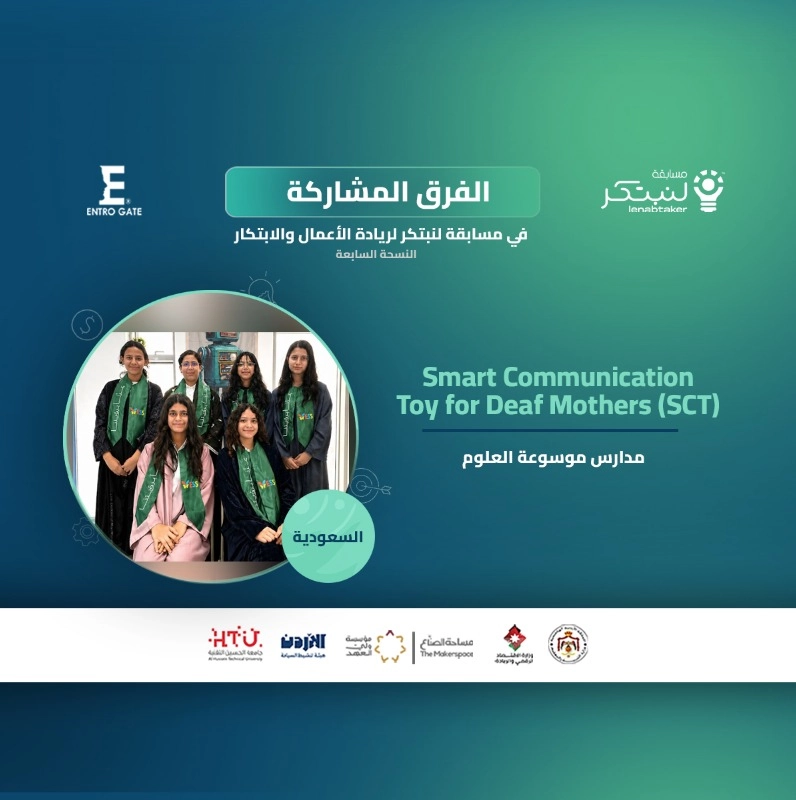


مشروع: Smart Communication Toy for Deaf Mothers (SCT)
Our project, Smart Communication Toy for Deaf Mothers (SCT), addresses a critical communication gap between deaf mothers and their young children under the age of five who have not yet developed spoken or sign language skills. This gap can lead to daily challenges, emotional frustration, and potential safety risks, as mothers may struggle to understand their children’s immediate needs such as hunger, discomfort, or emergencies. To solve this problem, we developed an innovative assistive system consisting of a smart interactive toy connected wirelessly to a wearable bracelet. The child interacts with the toy through simple actions such as pressing buttons, shaking, or hugging it, and each action sends a radio-frequency signal (without requiring internet) to the mother’s bracelet, which responds with clear color-coded light alerts indicating specific needs—for example, green for hunger, yellow for bathroom needs, red for emergencies, and multicolor lights for emotional expression. The project includes three main components: the smart communication toy, the wearable bracelet, and a play-based training program designed to help both mother and child learn and adapt to the system effectively. What makes this project unique is its simplicity, affordability, and reliability, as it works offline, is specifically designed for deaf mothers with non-verbal children, and combines communication, education, and emotional bonding in a single solution. Additionally, it enhances safety and independence while strengthening the relationship between mother and child. We have already developed an initial prototype using cardboard materials to test functionality and user interaction, and we are currently working on an improved version using 3D printing for better durability and usability. In the future, we aim to expand this system into a comprehensive assistive communication platform by integrating artificial intelligence and camera-based recognition to better understand children’s behavior and context, connecting the system to IoT platforms for emergency alerts and smart home responses, and developing a mobile application to track communication patterns and provide personalized insights. We also plan to collaborate with specialists in special education and therapy, partner with support organizations, and refine the design for large-scale production to make the solution widely accessible and impactful on a global level.